
Running a server from the command line takes know-how, and a control panel is the shortcut: websites, email, DNS and databases in one web interface. If you already use one, it’s probably cPanel. cPanel now prices its license by the number of accounts you host, and for anyone with lots of small accounts that made the bill a lot bigger, so people go looking for something else.
The good news hasn’t changed since we first wrote this in 2019: there are plenty of open-source cPanel alternatives, and most of them are free. What has changed is which projects are alive. We checked every one on this list on 2026-09-29.
Virtualmin (and Webmin)
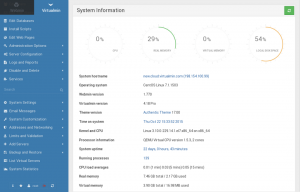
Still my favorite. Virtualmin sits on top of Webmin, a solid server admin panel in its own right. Webmin handles the machine: web server, database server and mail server configuration. Virtualmin adds the hosting side: virtual hosts, databases, mailboxes, DNS, hosting plans and site statistics.
It’s the most complete free panel I’ve used. There’s a free, open-source GPL edition and a paid Pro edition with extra features and support, and its installer supports Debian, Ubuntu and the main Red Hat-family distributions. The interface is busier than the others here. You get used to it.
Status in 2026: actively developed, GPL edition free.
HestiaCP
HestiaCP began as a fork of VestaCP and has long since become its own project with its own code. It’s free and open source under the GPLv3, it runs on Debian and Ubuntu, and it covers the basics cleanly: web, mail, DNS and databases per user, in an interface that looks a lot more finished than Vesta’s ever did.
The community is smaller than Virtualmin’s, and there’s no big company behind it. For a small multi-site server where you want something simple, it’s the one I’d reach for.
Status in 2026: actively maintained, with several releases in August and September 2026.
VestaCP
In 2019 I liked VestaCP for its clean interface and easy setup, and warned about its run of serious vulnerabilities. After that the project went quiet for years, and most of its users moved to HestiaCP.
It isn’t dead, though. The project announced it was back under active development in February 2024, and its GitHub repository has commits from this summer, including an installer for Ubuntu 24.04. Even so, given its security history and the gap in maintenance, I’d pick HestiaCP, which offers the same kind of panel with years of steady releases behind it.
Status in 2026: revived and getting commits, with a patchy track record.
CyberPanel
CyberPanel is built around OpenLiteSpeed, the open-source edition of LiteSpeed’s web server. The panel itself is free and open source, with optional paid add-ons and hosted services on top.
If you already like LiteSpeed, or you’re running mostly WordPress and want a panel designed around that web server, it’s worth a test. If you want Apache and a traditional layout, look elsewhere.
Status in 2026: actively developed.
CWP (Control Web Panel)
The panel I reviewed in 2019 as CentOS Web Panel now goes by Control Web Panel, since CentOS as we knew it is gone. It runs on Red Hat-family Linux, and it’s free, with a paid CWPpro edition for more features. One thing to know for a list called “open source”: CWP’s site describes the core as free but doesn’t say it’s open source.
It gives you fine-grained control over the server and plenty of features. The interface still isn’t pretty.
Status in 2026: still offered, under the new name.
aaPanel
aaPanel wasn’t on our 2019 list, and it belongs on this one. The core version is free, the site calls it open source, and there’s a paid Pro version that adds a web application firewall, multi-user accounts and priority support. It supports Ubuntu, Debian, AlmaLinux and other common distributions.
It’s quick to install and does a lot. Keep an eye on which features sit behind the Pro upgrade before you commit a server to it.
Status in 2026: actively offered, free core plus paid Pro.
Froxlor
Froxlor is the small, quiet one: free, open source under the GPL, and aimed at people who want a lightweight panel that stays out of the way. Current releases support Debian 12 and Ubuntu 24.04.
It won’t hold your hand the way the others do. If you’re comfortable on the command line and just want a tidy way to hand out web, mail and FTP accounts, that’s a feature.
Status in 2026: actively maintained.
When cPanel is still the right call
None of the above is a drop-in replacement for cPanel on a server full of other people’s sites. Pay for cPanel when:
- You host other people’s sites. Per-account isolation, per-account backups and a panel your customers already know save you support tickets every week.
- Email is part of the product. cPanel’s mail stack, spam filtering and per-domain mailboxes are the thing most free panels do least well.
- You resell. WHM’s reseller accounts and hosting packages are hard to match.
- You run a shared server with CloudLinux. Per-account limits alongside cPanel’s per-account tools is a well-worn setup, and help is easy to find.
- Your staff already know WHM. Retraining a support team costs more than a license.
On a dedicated server the math is friendlier than it looks, because one bare-metal license covers 100 accounts. We break down the tiers in what a cPanel license costs, and our cPanel dedicated servers come with the license on the order form.
If you host a handful of your own sites, pick one of the free panels above and keep the money.